Introduction to Jetstream2
Note: This page was generated from a PowerPoint file. Formatting has been simplified.
Introduction to Jetstream2
Introduction to Jetstream2
Any opinions, findings, conclusions, or recommendations expressed in this material are those of the author(s) and do not necessarily reflect the views of the University of Hawaiʻi.

Before We Begin
Before We Begin
You should have your ACCESS ID to be able to use Jetstream2.
What is Jetstream2?
What is Jetstream2?
Jetstream2 is a high-performance cloud computing environment which provides resources to researchers and educators across the US through the National Science Foundation (NSF)-funded Advanced Cyberinfrastructure Coordination Ecosystem: Services & Support (ACCESS) program. Jetstream2 is designed to be user-friendly and accessible to both advanced users and those who have had little to no experience with high-performance computing (HPC) resources. Jetstream2 is run by the Pervasive Technology Institute at Indiana University.



Regional Partners
Regional Partners
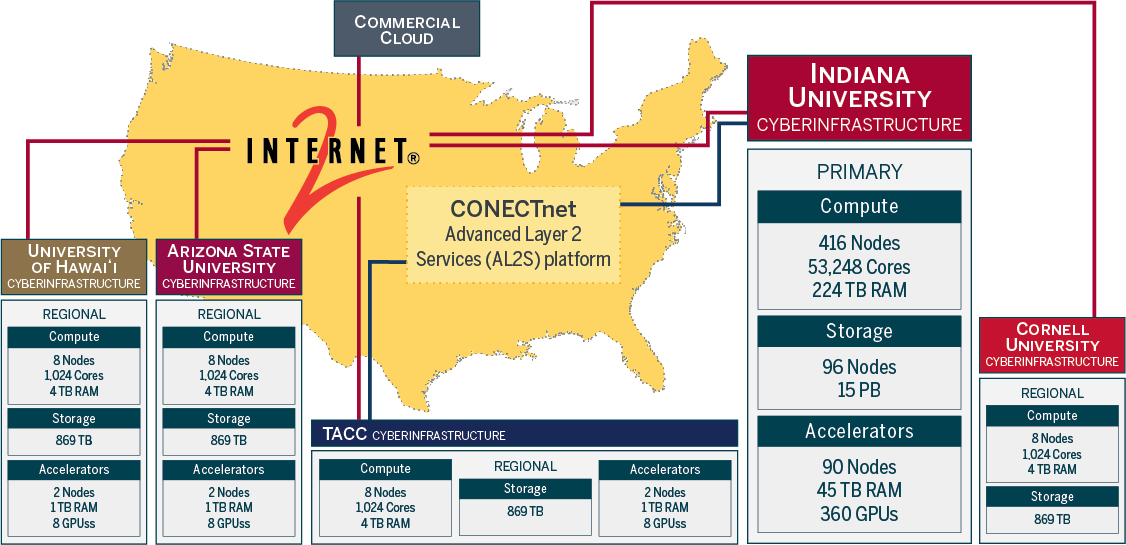
Features
Features
Create and administer your own virtual machines - Install and configure software - Control via web shell, virtual desktop, or through SSH
On-demand resources, no queues or runtime limits
Internet access with persistent IPs, ideal for web hosting or gateways
Resources are available at no cost to end users thanks to support from the NSF
Specifications
Specifications
8 petaFLOPS cloud computing system, 17.2 petabytes of storage
Compute: 384 nodes AMD EPYC CPUs with 128 cores + 512gb RAM
GPU: - 90 nodes, 4 NVIDIA A100 40gb - *24 nodes 2 NVIDIA H100 80GB - *8 nodes 4 NVIDIA L40S 48GB
Large Memory: 32 nodes, up to 1TB of RAM
NVMe default VM root disks and storage
CEPH storage for additional storage volumes that can be mounted on a VM
*require request or special allocations
Jetstream2 Resource Types
Jetstream2 Resource Types
CPU: 1 CPU core, 3 GB RAM up to 64 CPU cores, 250 GB RAM*
Large Memory: Up to 128 CPU cores, 1000 GB RAM - Double the RAM of equivalent CPU instances
GPU: From 8 GB VRAM, 3 CPU cores, 15 GB RAM partial GPU up to a fullNVIDIA GPU, 32 CPU cores, 125 GB RAM
Storage: 1 TB default for volumes, more on request
Default CPU instances capped at 64 CPU cores. 128 CPU cores,500 GB available by request and with proper justification.
Use Cases
Use Cases
Teaching a course - Give students access to powerful computing for high-performance analysis - Individual virtual machines for practicing network security and reproducible development environments
Working with code - Write, debug, and execute with interactive GUI applications - Use GPUs to train and refine ML/LLMs
Long running services - Databases - Web applications - science gateway - Inference services
Sharing with lab, students and colleagues - Host a file server or database - Receive, store, and serve data - Shared Environment (all dependencies etc)
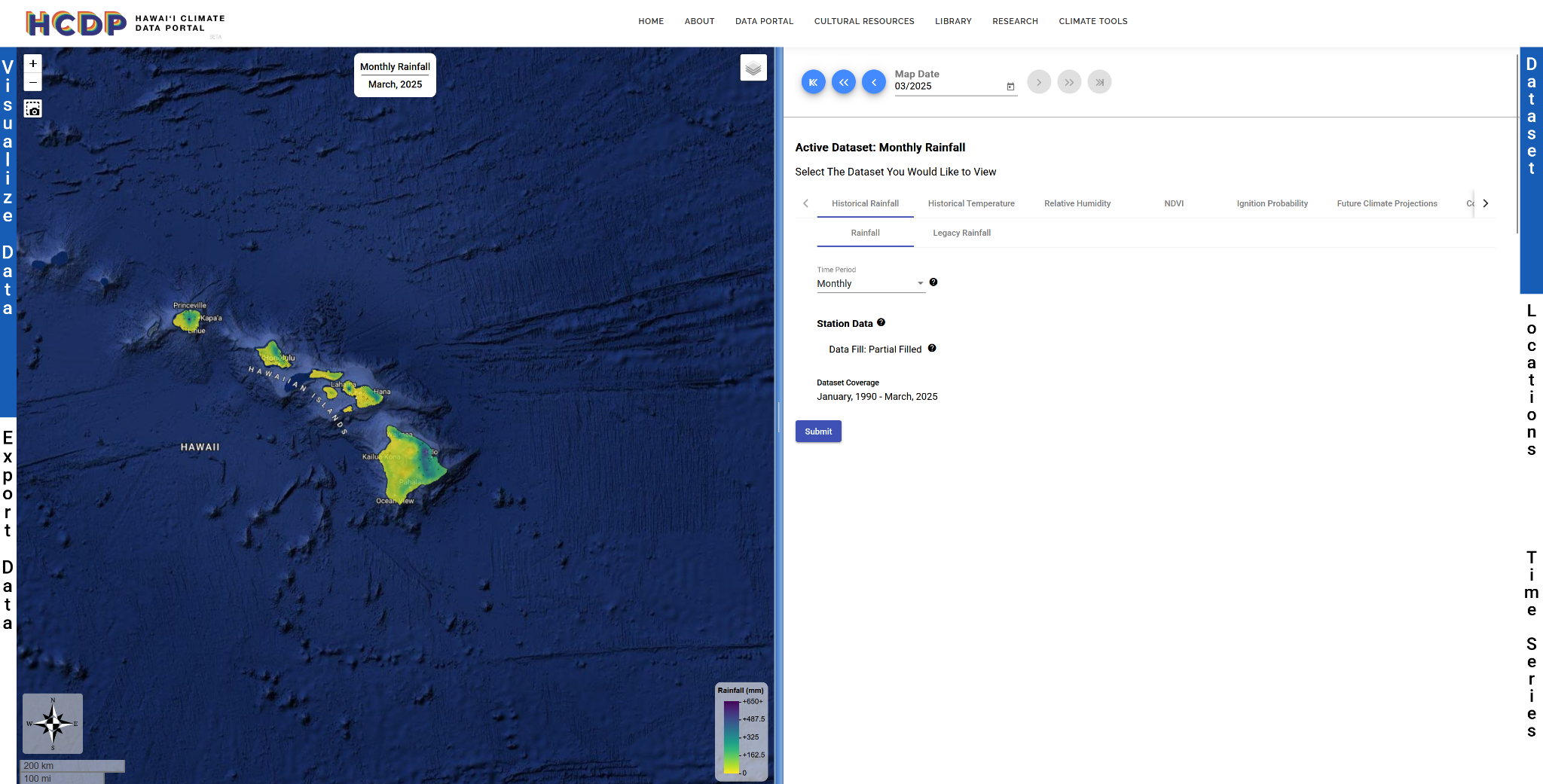
Use Case: Hawaiʻi Climate Data Portal (HCDP)
Use Case: Hawaiʻi Climate Data Portal (HCDP)
HCDP Allows users to visualize and download decades’ worth of climate data
Jetstream2 Interfaces: Exosphere
Jetstream2 Interfaces: Exosphere
Primary interface, most user-friendly
Accessible via Guacamole web shell, graphical virtual desktop (optional), SSH
Most limited
Focus of tutorial
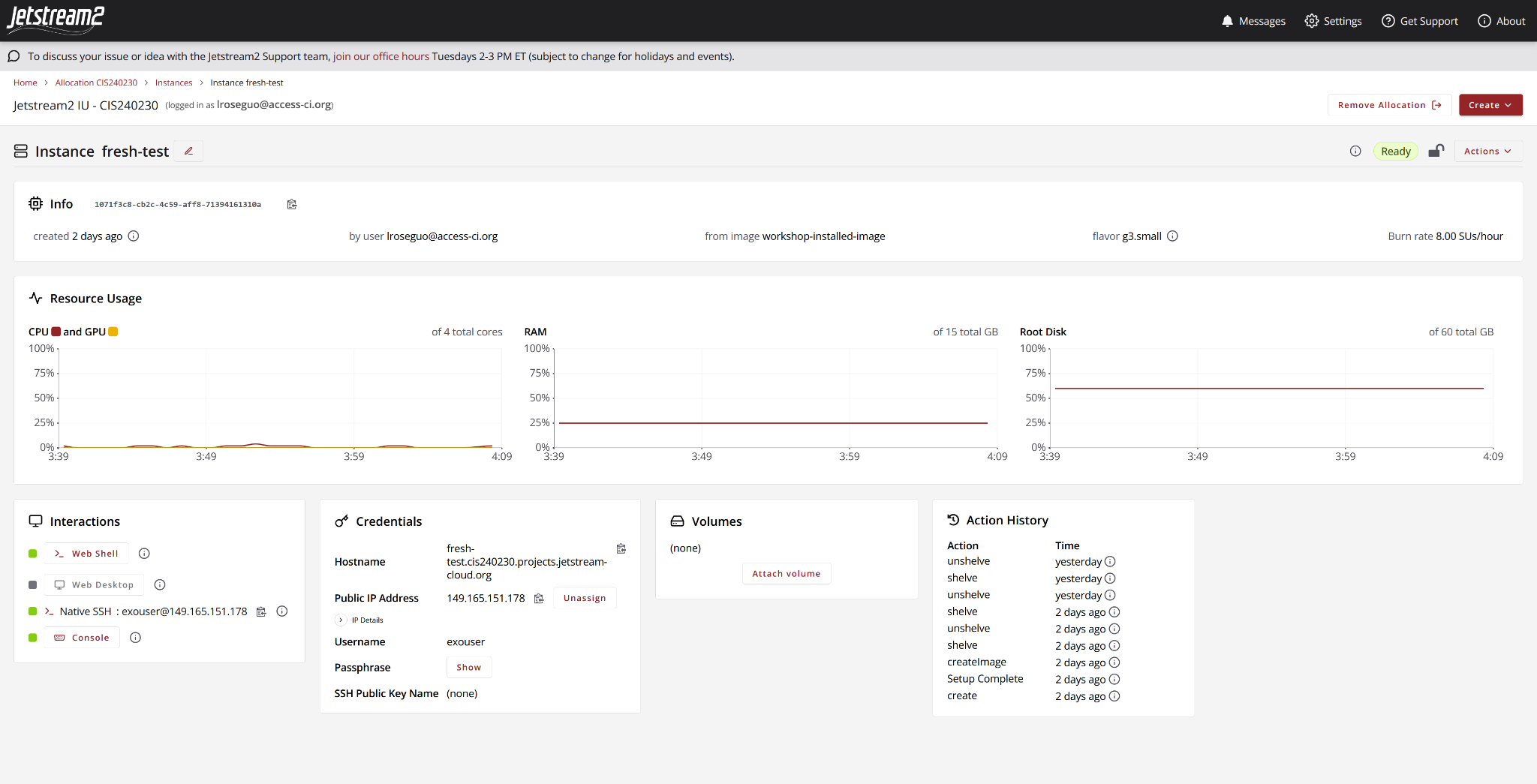
Exosphere Web App
Jetstream2 Interfaces: Horizon
Jetstream2 Interfaces: Horizon
For advanced users, more tools, default OpenStack dashboard
Most complete UI, but not as user-friendly
Supports almost all functionality of the OpenStack API as the command line interface
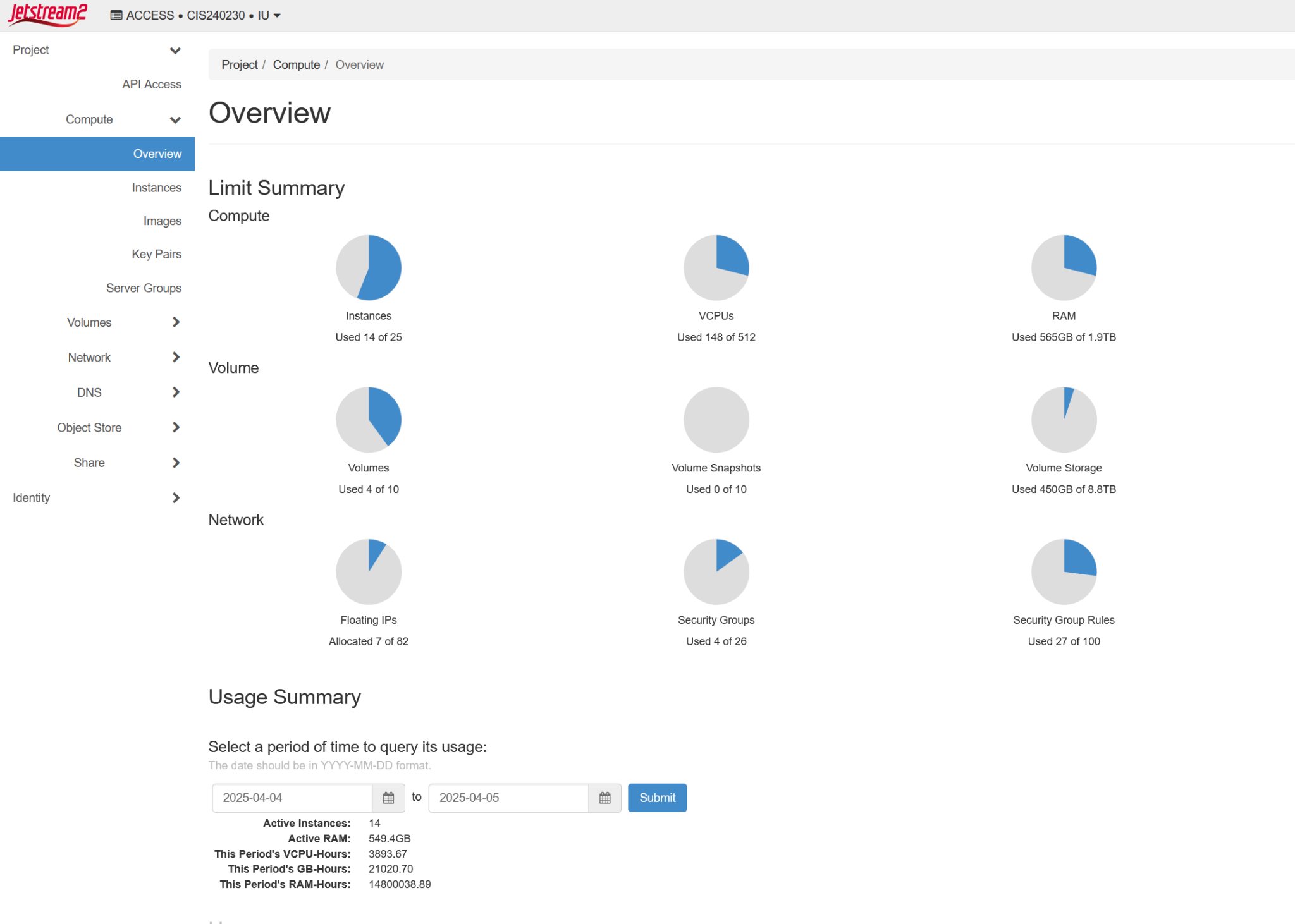
Horizon Login
Jetstream2 Interfaces: CACAO
Jetstream2 Interfaces: CACAO
For advanced users, useful for building clusters or JupyterHub
In Alpha
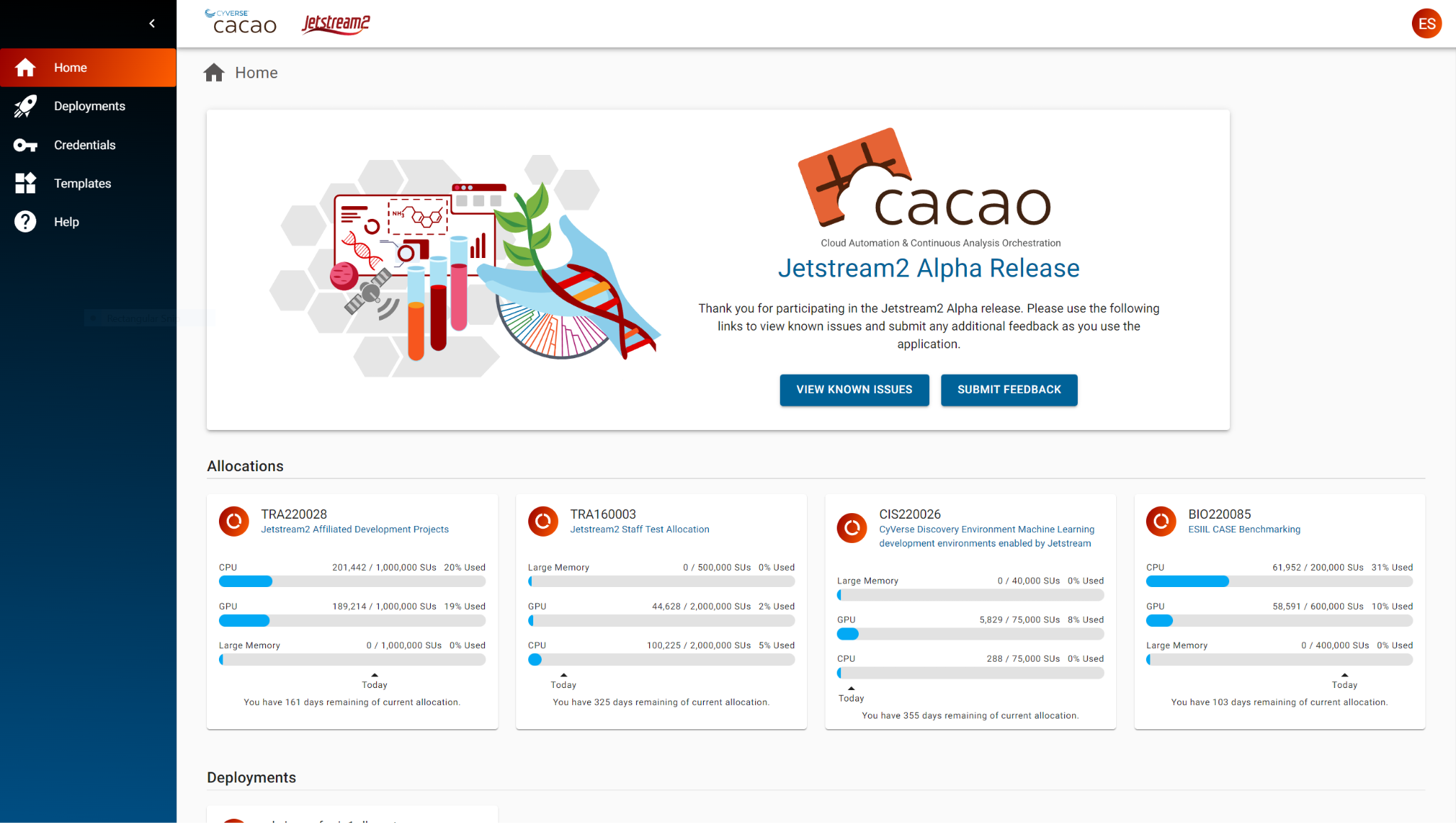
CACAO Login
Limitations, Caveats, and Responsibilities
Limitations, Caveats, and Responsibilities
Research or education use only - No hosting personal or commercial websites
Jetstream2 is not primarily a storage/archival service - Do you have a plan for your data if your allocation does not get renewed?
Data protected by HIPAA, FERPA, ITAR and other federal or security or privacy laws, as well as classified information, is not currently permitted to be stored on Jetstream2.
Users are responsible for administrating their own VMs - Jetstream2 Security FAQ
Windows images are not officially supported
Appendix D: Acronyms
Appendix D: Acronyms
NSF - National Science Foundation
ACCESS - Advanced Cyberinfrastructure Coordination Ecosystem: Services & Support
NAIRR Pilot - National Artificial Intelligence Research Resource Pilot
HPC - High-Performance Computing
VM - Virtual Machine
EPSCoR - Established Program to Stimulate Competitive Research
LLM - Large Language Model
HIPAA - Health Insurance Portability and Accountability Act
FERPA - Family Educational Rights and Privacy Act
ITAR - International Traffic Arms and Regulations Act
IU - Indiana University